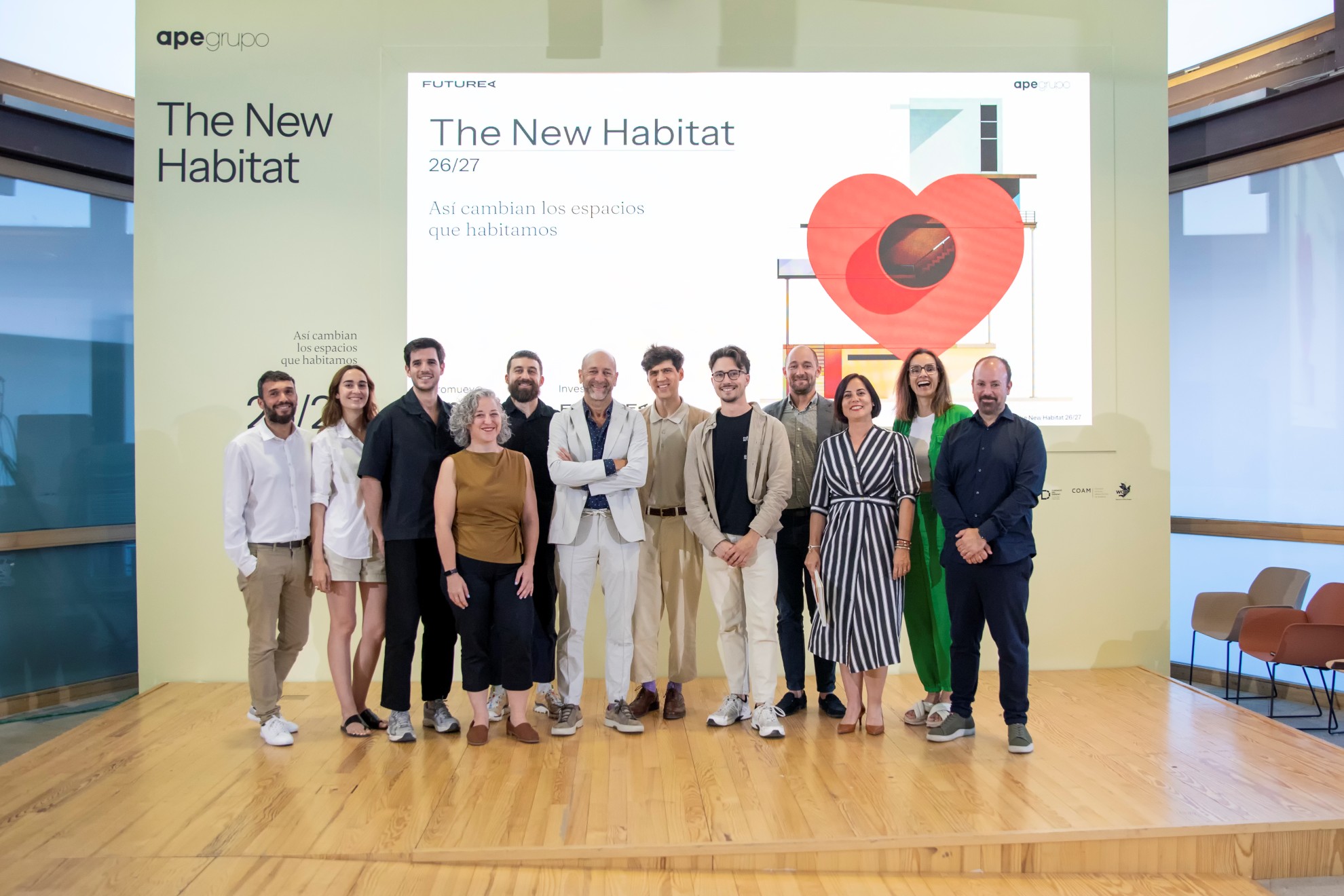
The fifth edition of the report The New Habitat 26/27, presented by APE Grupo in Madrid, confirms a profound transformation in the way spaces are conceived: physical and mental wellbeing has become the foremost priority for architects and interior designers, overtaking aesthetics and functionality.
Over 74% of professionals in the sector believe that design enhances people’s wellbeing, placing it as a top priority in a context shaped by loneliness, uncertainty, and emotional challenges. Design thus emerges as a strategic tool with tangible impact on health, sustainability, and the economy.
The report, developed in collaboration with Futurea and institutions such as COAM, CGCODDI, WOD, Bernardí and the Fundació del Disseny, gathers insights from 10 international experts and 360 design professionals across Spain. Functionality is being redefined to reflect contemporary lifestyles and emotional needs, while profitability is increasingly viewed as the ability to foster connections. Sustainability, meanwhile, is approached from a technical and structural perspective, with clients willing to assume an average cost increase of 24.4% for more sustainable solutions. An overall increase of 18.3% in design investment is forecast for the coming year.
Housing: Towards multifunctional and resilient spaces
The home is becoming the centre of everyday life, encompassing work, leisure, and self-care. Flexibility and inclusivity are cited by 32% of professionals as key drivers in residential design. In response to trends such as the rise of single-person households and the LAT (Living Apart Together) model, there is growing demand for versatile and adaptable housing solutions.
Resilient architecture is also gaining ground, with homes expected to address natural disasters and climate change through adaptive materials and structures. A 16% rise in residential design investment is anticipated, with sustainability as the central focus.
Hospitality: Inclusion and experience as key differentiators
In the hospitality sector, empathy, accessibility and sustainability are shaping the evolution of design. Spaces are being adapted to accommodate a wide range of users — from neurodivergent individuals to multigenerational families — in line with a tourism industry that increasingly prioritises authentic over conventional experiences.
Hostels are evolving into curated and cultural environments, while hotels are opting for hybrid and personalised spaces. A 21.5% increase in design investment is expected in the hospitality sector.
Workplaces: From desks to ecosystems of wellbeing
Offices are transforming into environments that promote collaboration, creativity, and a sense of belonging. Health, ergonomics, and human connection are central to new models such as the Workshop Lab and the workplace ecosystem. A 16.3% rise in office design investment is projected for 2025.
Retail: Experiences beyond the act of purchase
In the face of growing online commerce, physical retail is being reimagined as an emotional and community-oriented space. Shops and shopping centres are transforming into hubs of culture, wellbeing, and social engagement — also for employees. A 20% increase in commercial design investment is anticipated.




 Return

